


Technical Breakdown of DeFi: Tools, Frameworks, and Blockchain Integration
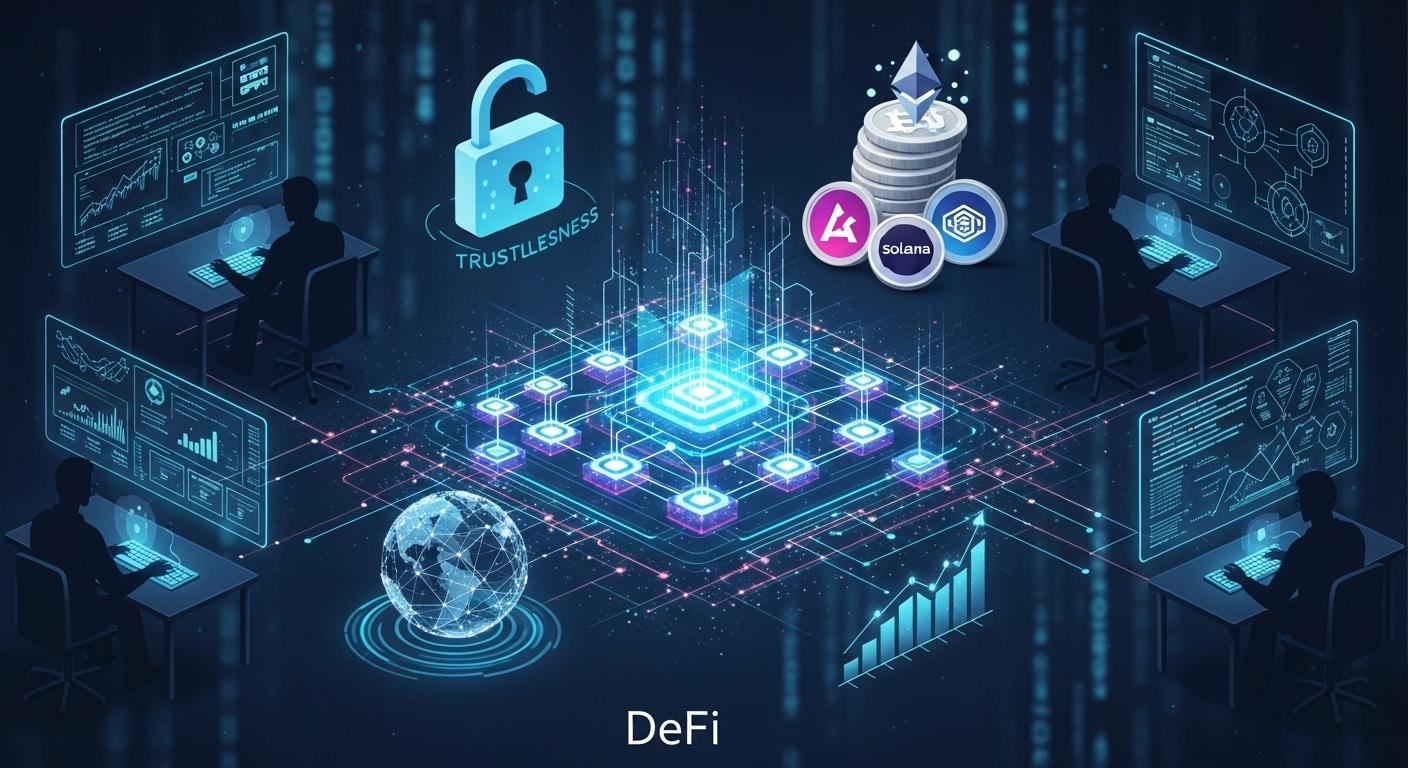
Decentralized finance is often explained through products such as lending, trading, staking, derivatives, and stablecoins. But the real engine of DeFi is technical infrastructure. A DeFi application is not one piece of software. It is usually a stack of smart contracts, token standards, wallet connections, indexing systems, oracle feeds, developer frameworks, and chain integrations working together in a hostile public environment. Ethereum’s developer documentation describes smart contracts as the programmable layer of the network and emphasizes composability, meaning contracts can interact with one another like open APIs. That design choice is one reason DeFi expanded so quickly: developers could build by combining existing onchain components instead of recreating the entire financial stack from scratch.
The scale of that ecosystem is no longer small. DefiLlama’s live dashboard says it tracks more than 7,000 DeFi protocols across more than 500 chains, which shows that DeFi is not confined to one blockchain or one product category anymore. It is a multichain software environment with a growing number of interoperable services, each relying on shared developer tools and standards.
The foundation: smart contracts and token standards
At the base of nearly every DeFi application is the smart contract. On Ethereum and other EVM-compatible chains, smart contracts hold assets, enforce business logic, calculate balances, and execute state changes when users submit transactions. Ethereum’s smart contract documentation notes that contracts are public and callable by other contracts, which is exactly what allows one DeFi protocol to plug into another. A lending market can call a token contract, a DEX router can call a liquidity pool, and a yield strategy can combine both in one workflow.
Token standards make that composability usable. Ethereum’s token standards documentation explains that standards help ensure tokens remain compatible with existing decentralized exchanges and applications. Without common interfaces, DeFi would be far more fragmented because every wallet, DEX, and lending app would need custom integrations for every asset. Standardization is what turns blockchain logic into shared infrastructure instead of isolated code silos.
This is where defi software development becomes distinct from ordinary app development. The engineer is not building against a private backend with full administrative control. They are building against public state, public interfaces, and economic systems that other protocols and users can interact with directly. That makes interface design, permissions, and execution logic central from the first day of development.
Development frameworks that power DeFi engineering
Modern DeFi teams rely on specialized frameworks because smart contract development needs more than a text editor and deployment script. Hardhat remains one of the most widely used environments. Its documentation describes it as a development environment for Ethereum software, and the main Hardhat site says it includes testing, deployment, code coverage, verification, and other tools needed for Solidity development. Hardhat Ignition adds a declarative deployment system that lets teams define contract instances and deployment operations in a more structured way.
In practice, Hardhat is valuable because DeFi development is iterative. Contracts need to be compiled repeatedly, tested against local and staged environments, and deployed in a reproducible way. Deployment is not a trivial step when the software will hold real assets. A structured deployment framework reduces the chance of configuration mistakes and makes contract rollouts easier to audit and repeat.
Foundry is another major framework in the EVM ecosystem, even though the search results here did not surface its official documentation cleanly. Because I do not want to rely on weaker sources for it, I will keep this point narrow: many DeFi teams now use multiple toolchains rather than one, typically combining contract testing, scripting, and deployment tools according to their workflow. Hardhat is the clearest primary-source example from the material I checked.
On the application side, libraries such as viem are increasingly important. Viem describes itself as a lightweight, composable, and type-safe TypeScript interface for Ethereum. That matters because DeFi front ends constantly read blockchain state, prepare transactions, decode contract responses, and coordinate wallet actions. A poor application-layer integration can make a strong protocol feel broken to users, even if the contract itself is fine.
Smart contract libraries and reusable building blocks
No serious DeFi team writes every primitive from scratch. OpenZeppelin Contracts exists to provide battle-tested libraries for Ethereum and other EVM chains, including standard token implementations, utilities, governance modules, and secure permission systems. Its documentation highlights token standards, access control, governance, and utilities as core features.
That matters because DeFi protocols often repeat the same patterns. They need ERC-20 behavior, role-based administration, pause functionality, ownership or governance checks, and safe arithmetic or helper functions. Reusing known libraries lowers implementation risk and speeds up development, especially for common features that do not create product differentiation.
Access control deserves special attention. OpenZeppelin’s access control documentation warns that permissions can govern minting, voting, freezing transfers, and many other critical functions, and that poor access control can compromise the whole system. In DeFi, those permissions may include treasury withdrawals, parameter changes, oracle updates, and emergency pauses. So a protocol’s security often depends as much on role design as on business logic.
This is one reason decentralized finance development is really about system design rather than only contract writing. A robust protocol needs secure contract modules, clear role boundaries, and predictable upgrade or governance controls, not just working functions.
Oracles: connecting DeFi to the outside world
Purely onchain logic is not enough for most financial applications. Lending protocols need price data. Derivatives need reference rates. Cross-chain products may need sequencer health checks. Chainlink’s documentation says Data Feeds are used to connect smart contracts to real-world data such as asset prices, reserve balances, and L2 sequencer health. Its price feed documentation adds that these feeds are aggregated from many data sources by a decentralized set of independent node operators.
This is one of the most important technical facts in DeFi. A protocol may have correct lending math or swap logic, but if the oracle input is weak, manipulated, or stale, the application can still fail. In other words, blockchain integration in DeFi is not only about deploying contracts to a chain. It is also about integrating reliable data paths into the protocol’s execution model.
Indexing and the data layer
Raw blockchain data is hard to query efficiently for user-facing applications. DeFi dashboards, portfolio trackers, and analytics pages usually need indexed event and state data rather than repeated low-level RPC calls. The Graph’s documentation explains that a subgraph is a custom, open API that extracts blockchain data, processes it, stores it, and makes it queryable via GraphQL.
This indexing layer is what makes many DeFi interfaces practical. A lending dashboard can display borrow balances and liquidation history quickly because a subgraph or similar indexing service has already processed the underlying chain data. A DEX analytics page can show volume and fees because events have been extracted and organized into structured queries. Without indexing, the front end would often be too slow or too expensive to operate at scale.
Blockchain integration in a multichain world
DeFi is now deeply multichain. DefiLlama’s chain rankings page says it compares more than 500 blockchains by TVL, fees, and DeFi activity. That means builders increasingly have to think beyond one deployment target. Blockchain integration now includes wallet compatibility, RPC reliability, indexing support, oracle availability, bridge assumptions, and execution cost differences across chains.
Ethereum’s developer docs still matter here because much of the DeFi ecosystem follows EVM patterns, even when deployed across multiple chains. Shared tooling, shared standards, and shared contract interfaces allow applications to move more easily across EVM-based environments. But the deployments are not identical in practice. Gas economics, finality assumptions, user behavior, and available infrastructure can differ sharply from chain to chain.
This is where defi platform development becomes an infrastructure challenge. It is not enough to copy a contract onto another chain. The team must also ensure the surrounding layers, including data feeds, indexing, front-end wallet support, and monitoring, behave reliably in that new environment.
Conclusion
A technical breakdown of DeFi shows that the sector is built on coordinated infrastructure rather than isolated apps. Smart contracts provide execution. Token standards provide compatibility. Hardhat and related frameworks support development and deployment. OpenZeppelin provides reusable contract building blocks. Viem helps applications interact with Ethereum safely. Chainlink feeds bring external data onchain. The Graph organizes blockchain data into usable APIs. Multichain deployment extends these systems across hundreds of networks. Together, these layers turn public blockchains into programmable financial backends. The sophistication of DeFi does not come from one clever contract. It comes from how well all of these technical layers work together under real economic pressure.

 English
 Arabic
 French
 Spanish
 Portuguese
 Deutsch
 Turkish
 Italiano
 Russian
 Romaian
 Portuguese (Brazil)
 Greek
Greek